- HOME
- Detail: YUTATOFUSHIGINANAKAMATACHI
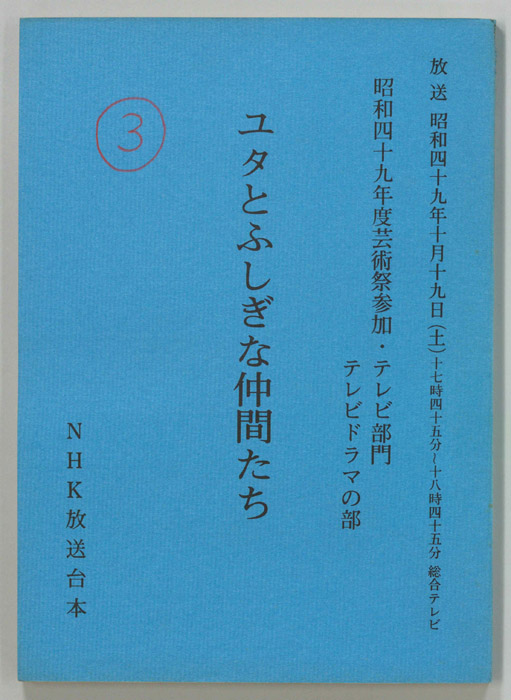
YUTATOFUSHIGINANAKAMATACHI
| Writer | |
|---|
| Major performers | |
|---|
| Original work | | Original name | |
|---|
| Original author | | Producer | |
|---|
| Theme song | | Broadcaster | NHK |
|---|
| Production company | | On Air date | 1974/10/19 |
|---|
| Broadcasting times | | Onair time | |
|---|
| Onair length | | Director | |
|---|
| Music staff | | Design staff | |
|---|
| Coaching staff | | Other staff | |
|---|
| Shooting location | | Management | N01-12333-00 |
|---|
| KANA | | Reading | |
|---|
| Classification | Scripts | Media | |
|---|
| Genre | | Screens version | |
|---|
| Transfer destination | National Diet Library | Deterioration | |
|---|
| Etc | | Tags | |
|---|
Synopsis
Yuta to Fushigina Nakamatachi, Yuta and his Strange Companions Yuuta , a sixth grader in elementary school, lost his father in a maritime accident and was transferred to a school in his mother’s hometown of Yunohana Village, a hot spring village in the Tohoku region. He cannot fit in with the other children and spends all his time lonely and on his own. One day, one of the village elders tells Yuuta about the legend of “zashiki-warashi,” which piques his interest, and one night under a full moon, Yuuta stays alone at a hot-spring inn where zashiki-warashi are said to appear. They eventually appear, and Yuta—they call him Yuta instead of Yuuta —becomes friends with Pedro and Monze, the leaders of zashiki-warashi, and gradually regains his energy. Yuta continues to get better and gradually begins to open up to the children of the village. But, this means saying goodbye to zashiki-warashi and maturing into adulthood.The original story was written by Tetsuo Miura—winner of the Akutagawa Prize—for Shincho Shonen Bunko. The drama series was broadcast in May 1974 as one of NHK’s Shonen Drama series. It was entered in the 1974 National Arts Festival and won the Excellence Award in the drama category in the television division. Since then, it was adapted to a musical for children—directed by Keita Asari of the Shiki Theatre Company in 1977—and won the Yomiuri Theatrical Advertising Award. Since 1989, the company has toured the country and continues to be performed to this day as a musical classic. In 2011, free performances were held in Tokyo and the Tohoku region for children affected by the Great East Japan Earthquake. The songs Tomodachi wa Iimonda and Ikiteirutte Subarashii were recorded by the actors of the Shiki Theatre Company and used in NHK’s show Minna no Uta and have become musical masterpieces for children that are performed on occasion even today.
- *The information in [] is reference information by our group's own survey, and it is not what is described in the original of the bibliography.
- *Regarding movies and plays, the description of the broadcast date column is 'Publication Date' 'Performance Day'.
- *Since Romanized notation is maked by machine conversion based on 'Kana', it may be inaccurate.
{
"onair_date": "1974/10/19",
"seisaku_kyoku": "NHK",
"arasuji": "Yuta to Fushigina Nakamatachi, Yuta and his Strange Companions Yuuta , a sixth grader in elementary school, lost his father in a maritime accident and was transferred to a school in his mother’s hometown of Yunohana Village, a hot spring village in the Tohoku region. He cannot fit in with the other children and spends all his time lonely and on his own. One day, one of the village elders tells Yuuta about the legend of “zashiki-warashi,” which piques his interest, and one night under a full moon, Yuuta stays alone at a hot-spring inn where zashiki-warashi are said to appear. They eventually appear, and Yuta—they call him Yuta instead of Yuuta —becomes friends with Pedro and Monze, the leaders of zashiki-warashi, and gradually regains his energy. Yuta continues to get better and gradually begins to open up to the children of the village. But, this means saying goodbye to zashiki-warashi and maturing into adulthood.The original story was written by Tetsuo Miura—winner of the Akutagawa Prize—for Shincho Shonen Bunko. The drama series was broadcast in May 1974 as one of NHK’s Shonen Drama series. It was entered in the 1974 National Arts Festival and won the Excellence Award in the drama category in the television division. Since then, it was adapted to a musical for children—directed by Keita Asari of the Shiki Theatre Company in 1977—and won the Yomiuri Theatrical Advertising Award. Since 1989, the company has toured the country and continues to be performed to this day as a musical classic. In 2011, free performances were held in Tokyo and the Tohoku region for children affected by the Great East Japan Earthquake. The songs Tomodachi wa Iimonda and Ikiteirutte Subarashii were recorded by the actors of the Shiki Theatre Company and used in NHK’s show Minna no Uta and have become musical masterpieces for children that are performed on occasion even today.",
"img": "N01-12333-00.jpg",
"genre": [
"Drama"
],
"onair_year": 1974,
"kyakuhon": "HAYASAKA Akira",
"id": "N01-12333-00",
"ikansaki": "National Diet Library",
"media": [
"TV"
],
"title": "YUTATOFUSHIGINANAKAMATACHI",
"class": "Scripts"
}
{"src":{"onair_date":"1974/10/19","seisaku_kyoku":"NHK","arasuji":"Yuta to Fushigina Nakamatachi, Yuta and his Strange Companions Yuuta , a sixth grader in elementary school, lost his father in a maritime accident and was transferred to a school in his mother’s hometown of Yunohana Village, a hot spring village in the Tohoku region. He cannot fit in with the other children and spends all his time lonely and on his own. One day, one of the village elders tells Yuuta about the legend of “zashiki-warashi,” which piques his interest, and one night under a full moon, Yuuta stays alone at a hot-spring inn where zashiki-warashi are said to appear. They eventually appear, and Yuta—they call him Yuta instead of Yuuta —becomes friends with Pedro and Monze, the leaders of zashiki-warashi, and gradually regains his energy. Yuta continues to get better and gradually begins to open up to the children of the village. But, this means saying goodbye to zashiki-warashi and maturing into adulthood.The original story was written by Tetsuo Miura—winner of the Akutagawa Prize—for Shincho Shonen Bunko. The drama series was broadcast in May 1974 as one of NHK’s Shonen Drama series. It was entered in the 1974 National Arts Festival and won the Excellence Award in the drama category in the television division. Since then, it was adapted to a musical for children—directed by Keita Asari of the Shiki Theatre Company in 1977—and won the Yomiuri Theatrical Advertising Award. Since 1989, the company has toured the country and continues to be performed to this day as a musical classic. In 2011, free performances were held in Tokyo and the Tohoku region for children affected by the Great East Japan Earthquake. The songs Tomodachi wa Iimonda and Ikiteirutte Subarashii were recorded by the actors of the Shiki Theatre Company and used in NHK’s show Minna no Uta and have become musical masterpieces for children that are performed on occasion even today.","img":"N01-12333-00.jpg","genre":["Drama"],"onair_year":1974,"kyakuhon":"HAYASAKA Akira","id":"N01-12333-00","ikansaki":"National Diet Library","media":["TV"],"title":"YUTATOFUSHIGINANAKAMATACHI","class":"Scripts"},"id":"N01-12333-00","kanri":"N01-12333-00","media":["TV"],"genre":["Drama"],"sub_genre":[],"tag1":[],"onair_date":"1974/10/19","seisaku_kyoku":"NHK","arasuji":"Yuta to Fushigina Nakamatachi, Yuta and his Strange Companions Yuuta , a sixth grader in elementary school, lost his father in a maritime accident and was transferred to a school in his mother’s hometown of Yunohana Village, a hot spring village in the Tohoku region. He cannot fit in with the other children and spends all his time lonely and on his own. One day, one of the village elders tells Yuuta about the legend of “zashiki-warashi,” which piques his interest, and one night under a full moon, Yuuta stays alone at a hot-spring inn where zashiki-warashi are said to appear. They eventually appear, and Yuta—they call him Yuta instead of Yuuta —becomes friends with Pedro and Monze, the leaders of zashiki-warashi, and gradually regains his energy. Yuta continues to get better and gradually begins to open up to the children of the village. But, this means saying goodbye to zashiki-warashi and maturing into adulthood.The original story was written by Tetsuo Miura—winner of the Akutagawa Prize—for Shincho Shonen Bunko. The drama series was broadcast in May 1974 as one of NHK’s Shonen Drama series. It was entered in the 1974 National Arts Festival and won the Excellence Award in the drama category in the television division. Since then, it was adapted to a musical for children—directed by Keita Asari of the Shiki Theatre Company in 1977—and won the Yomiuri Theatrical Advertising Award. Since 1989, the company has toured the country and continues to be performed to this day as a musical classic. In 2011, free performances were held in Tokyo and the Tohoku region for children affected by the Great East Japan Earthquake. The songs Tomodachi wa Iimonda and Ikiteirutte Subarashii were recorded by the actors of the Shiki Theatre Company and used in NHK’s show Minna no Uta and have become musical masterpieces for children that are performed on occasion even today.","img":"N01-12333-00.jpg","onair_year":1974,"kyakuhon":"HAYASAKA Akira","ikansaki":"National Diet Library","title":"YUTATOFUSHIGINANAKAMATACHI","class":"Scripts"}