- HOME
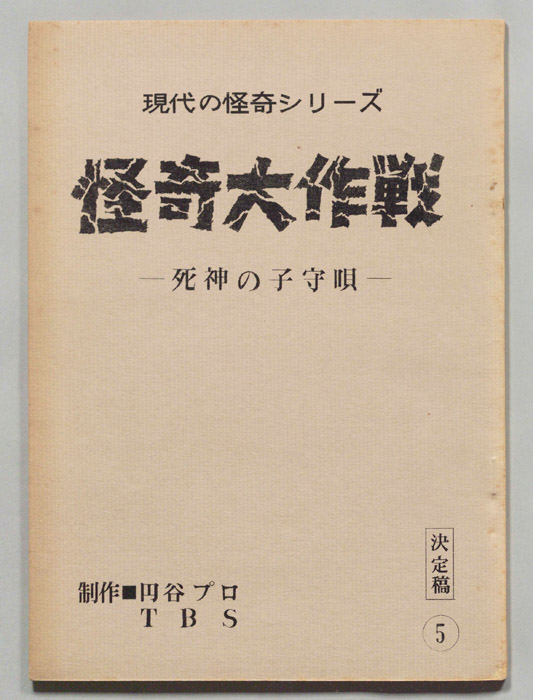
- Detail: KAIKIDAISAKUSEN
KAIKIDAISAKUSEN
| Writer | |
|---|
| Major performers | |
|---|
| Original work | | Original name | |
|---|
| Original author | | Producer | |
|---|
| Theme song | | Broadcaster | TBS HOLDINGS, INC. |
|---|
| Production company | | On Air date | Unknown |
|---|
| Broadcasting times | 5 | Onair time | |
|---|
| Onair length | | Director | |
|---|
| Music staff | | Design staff | |
|---|
| Coaching staff | | Other staff | |
|---|
| Shooting location | | Management | N01-51082-00 |
|---|
| KANA | | Reading | |
|---|
| Classification | Scripts | Media | |
|---|
| Genre | | Screens version | final manuscript |
|---|
| Transfer destination | National Diet Library | Deterioration | |
|---|
| Etc | | Tags | |
|---|
Synopsis
Operation: Mystery T he early 1970s witnesses a series of bizarre cases that the police cannot solve. Fully recognizing the critical importance of forensic investigation, Tadashi Matoya, former head of the Criminal Identification Section at the Tokyo Metropolitan Police Department, launches a private organization called the Science Research Institute (SRI) after leaving the police force. Matoya solves numerous mysterious cases with his team: Shiro Maki, a specialist in science, Kyosuke Misawa, a graduate of the National Defense Academy, and Saori Ogawa, who conducts scientific analysis and communication support. Although produced by Tsuburaya Productions, the series does not feature monsters or heroes. Each 30-minute standalone episode revolves around realistic forensic investigation, earning the series lasting popularity among adults too. The series is mostly comprised of mysterious, horror-oriented episodes, such as Episode 1, “Kabenuke Otoko” (the man who passes through walls), in which the mystery can be explained by applying a magic trick, an episode about a vampire, where the mystery remains unsolved, and an episode featuring marionettes. Partly due to this composition, a total of 11 scriptwriters, including Tetsuo Kinjo, Shozo Uehara, Mamoru Sasaki, Shinichi Ichikawa, and others who would later lead the TV drama industry, took part in the series. Episode 24, “Kyoki Ningen” (crazed maniacs) is still considered problematic in view of Article 39 of the Constitution of Japan. Therefore, this episode is missing from the series and is unavailable even today in the 21st century. Produced by TBS and Tsuburaya Productions, the series aired on Sundays at 7:00 p.m. from September 1968 to March 1969. Yasumi Hara played Matoya, the team leader, with Shin Kishida playing his right-hand man. In 2007, NHK produced a remake titled Kaiki Daisakusen Secando Fairu (Operation: Mystery, Second File), which featured the SRI. Another remake was released in 2013, titled Kaiki Daisakusen Misuteri Fairu (Operation: Mystery, Mystery Files).
- *The information in [] is reference information by our group's own survey, and it is not what is described in the original of the bibliography.
- *Regarding movies and plays, the description of the broadcast date column is 'Publication Date' 'Performance Day'.
- *Since Romanized notation is maked by machine conversion based on 'Kana', it may be inaccurate.
{
"seisaku_kyoku": "TBS HOLDINGS, INC.",
"arasuji": "Operation: Mystery T he early 1970s witnesses a series of bizarre cases that the police cannot solve. Fully recognizing the critical importance of forensic investigation, Tadashi Matoya, former head of the Criminal Identification Section at the Tokyo Metropolitan Police Department, launches a private organization called the Science Research Institute (SRI) after leaving the police force. Matoya solves numerous mysterious cases with his team: Shiro Maki, a specialist in science, Kyosuke Misawa, a graduate of the National Defense Academy, and Saori Ogawa, who conducts scientific analysis and communication support. Although produced by Tsuburaya Productions, the series does not feature monsters or heroes. Each 30-minute standalone episode revolves around realistic forensic investigation, earning the series lasting popularity among adults too. The series is mostly comprised of mysterious, horror-oriented episodes, such as Episode 1, “Kabenuke Otoko” (the man who passes through walls), in which the mystery can be explained by applying a magic trick, an episode about a vampire, where the mystery remains unsolved, and an episode featuring marionettes. Partly due to this composition, a total of 11 scriptwriters, including Tetsuo Kinjo, Shozo Uehara, Mamoru Sasaki, Shinichi Ichikawa, and others who would later lead the TV drama industry, took part in the series. Episode 24, “Kyoki Ningen” (crazed maniacs) is still considered problematic in view of Article 39 of the Constitution of Japan. Therefore, this episode is missing from the series and is unavailable even today in the 21st century. Produced by TBS and Tsuburaya Productions, the series aired on Sundays at 7:00 p.m. from September 1968 to March 1969. Yasumi Hara played Matoya, the team leader, with Shin Kishida playing his right-hand man. In 2007, NHK produced a remake titled Kaiki Daisakusen Secando Fairu (Operation: Mystery, Second File), which featured the SRI. Another remake was released in 2013, titled Kaiki Daisakusen Misuteri Fairu (Operation: Mystery, Mystery Files).",
"img": "N01-51082-00.jpg",
"onair_year": 0,
"media": [
"TV"
],
"title": "KAIKIDAISAKUSEN",
"version": "final manuscript",
"onair_count": "5",
"onair_date": "(?)",
"genre": [
"Drama-Special Effects"
],
"kyakuhon": "SASAKI Mamoru",
"id": "N01-51082-00",
"ikansaki": "National Diet Library",
"class": "Scripts"
}
{"src":{"seisaku_kyoku":"TBS HOLDINGS, INC.","arasuji":"Operation: Mystery T he early 1970s witnesses a series of bizarre cases that the police cannot solve. Fully recognizing the critical importance of forensic investigation, Tadashi Matoya, former head of the Criminal Identification Section at the Tokyo Metropolitan Police Department, launches a private organization called the Science Research Institute (SRI) after leaving the police force. Matoya solves numerous mysterious cases with his team: Shiro Maki, a specialist in science, Kyosuke Misawa, a graduate of the National Defense Academy, and Saori Ogawa, who conducts scientific analysis and communication support. Although produced by Tsuburaya Productions, the series does not feature monsters or heroes. Each 30-minute standalone episode revolves around realistic forensic investigation, earning the series lasting popularity among adults too. The series is mostly comprised of mysterious, horror-oriented episodes, such as Episode 1, “Kabenuke Otoko” (the man who passes through walls), in which the mystery can be explained by applying a magic trick, an episode about a vampire, where the mystery remains unsolved, and an episode featuring marionettes. Partly due to this composition, a total of 11 scriptwriters, including Tetsuo Kinjo, Shozo Uehara, Mamoru Sasaki, Shinichi Ichikawa, and others who would later lead the TV drama industry, took part in the series. Episode 24, “Kyoki Ningen” (crazed maniacs) is still considered problematic in view of Article 39 of the Constitution of Japan. Therefore, this episode is missing from the series and is unavailable even today in the 21st century. Produced by TBS and Tsuburaya Productions, the series aired on Sundays at 7:00 p.m. from September 1968 to March 1969. Yasumi Hara played Matoya, the team leader, with Shin Kishida playing his right-hand man. In 2007, NHK produced a remake titled Kaiki Daisakusen Secando Fairu (Operation: Mystery, Second File), which featured the SRI. Another remake was released in 2013, titled Kaiki Daisakusen Misuteri Fairu (Operation: Mystery, Mystery Files).","img":"N01-51082-00.jpg","onair_year":0,"media":["TV"],"title":"KAIKIDAISAKUSEN","version":"final manuscript","onair_count":"5","onair_date":"(?)","genre":["Drama-Special Effects"],"kyakuhon":"SASAKI Mamoru","id":"N01-51082-00","ikansaki":"National Diet Library","class":"Scripts"},"id":"N01-51082-00","kanri":"N01-51082-00","media":["TV"],"genre":["Drama-Special Effects"],"sub_genre":[],"tag1":[],"seisaku_kyoku":"TBS HOLDINGS, INC.","arasuji":"Operation: Mystery T he early 1970s witnesses a series of bizarre cases that the police cannot solve. Fully recognizing the critical importance of forensic investigation, Tadashi Matoya, former head of the Criminal Identification Section at the Tokyo Metropolitan Police Department, launches a private organization called the Science Research Institute (SRI) after leaving the police force. Matoya solves numerous mysterious cases with his team: Shiro Maki, a specialist in science, Kyosuke Misawa, a graduate of the National Defense Academy, and Saori Ogawa, who conducts scientific analysis and communication support. Although produced by Tsuburaya Productions, the series does not feature monsters or heroes. Each 30-minute standalone episode revolves around realistic forensic investigation, earning the series lasting popularity among adults too. The series is mostly comprised of mysterious, horror-oriented episodes, such as Episode 1, “Kabenuke Otoko” (the man who passes through walls), in which the mystery can be explained by applying a magic trick, an episode about a vampire, where the mystery remains unsolved, and an episode featuring marionettes. Partly due to this composition, a total of 11 scriptwriters, including Tetsuo Kinjo, Shozo Uehara, Mamoru Sasaki, Shinichi Ichikawa, and others who would later lead the TV drama industry, took part in the series. Episode 24, “Kyoki Ningen” (crazed maniacs) is still considered problematic in view of Article 39 of the Constitution of Japan. Therefore, this episode is missing from the series and is unavailable even today in the 21st century. Produced by TBS and Tsuburaya Productions, the series aired on Sundays at 7:00 p.m. from September 1968 to March 1969. Yasumi Hara played Matoya, the team leader, with Shin Kishida playing his right-hand man. In 2007, NHK produced a remake titled Kaiki Daisakusen Secando Fairu (Operation: Mystery, Second File), which featured the SRI. Another remake was released in 2013, titled Kaiki Daisakusen Misuteri Fairu (Operation: Mystery, Mystery Files).","img":"N01-51082-00.jpg","onair_year":0,"title":"KAIKIDAISAKUSEN","version":"final manuscript","onair_count":"5","onair_date":"(?)","kyakuhon":"SASAKI Mamoru","ikansaki":"National Diet Library","class":"Scripts"}