- HOME
- Detail: RYUUSEININGENZŌN
RYUUSEININGENZŌN
| Writer | |
|---|
| Major performers | |
|---|
| Original work | | Original name | |
|---|
| Original author | | Producer | |
|---|
| Theme song | | Broadcaster | [Nippon Television Nippon Educational Televisionwork Corporation] |
|---|
| Production company | | On Air date | Unknown |
|---|
| Broadcasting times | | Onair time | |
|---|
| Onair length | | Director | |
|---|
| Music staff | | Design staff | |
|---|
| Coaching staff | | Other staff | |
|---|
| Shooting location | | Management | N01-51231-00 |
|---|
| KANA | | Reading | |
|---|
| Classification | Scripts | Media | |
|---|
| Genre | | Screens version | final manuscript |
|---|
| Transfer destination | National Diet Library | Deterioration | |
|---|
| Etc | | Tags | |
|---|
Synopsis
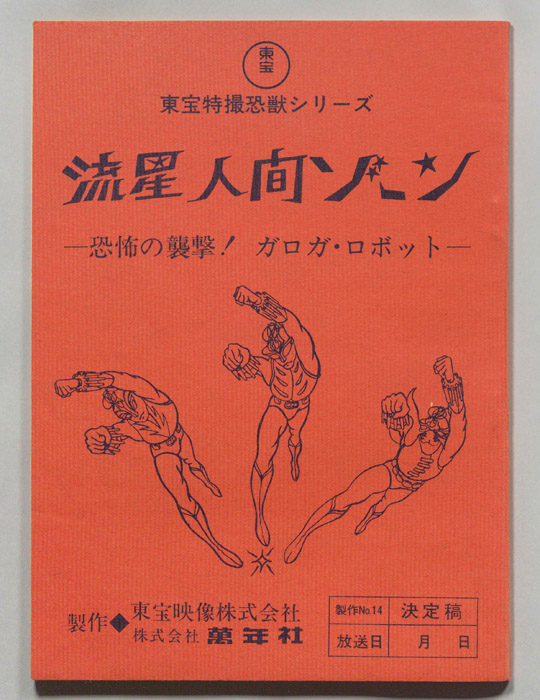
Zone Fighter Peaceland, a peaceful planet, is invaded by the Garogans, aliens who plan to conquer the entire cosmos. The inhabitants resist, but in vain, and they are forced out of their home planet. Each Peaceland family wanders around in space separately in search of a safe place to settle. One of those space refugee families ends up on Earth. There, they start a new life as a human family under the name Sakimori. However, the Garogans launch an assault on Earth with intentions to invade it. The Sakimori family’s oldest son, Hikaru, transforms into Zone Fighter to rise up and fight in defense of his second home planet, Earth.Zone Fighter aired on the Nippon Television network from April through September 1973. Toho Studios participated in the production, marking its entry into TV series industry. As the series coincided with the second Kaiju Boom, Ishiro Honda and Jun Fukuda, both directors of Godzilla movies, were involved in the production, along with guest appearances of monsters such as Godzilla and King Ghidorah.Hikaru grows in size when transforming into Zone Fighter. When he needs to fight colossal monsters, he can grow even larger into a Godzilla-sized giant by uttering the command “Zone Double Fight!”As the Sakimoris live as family on Earth, Hikaru’s parents and younger brother and sister can also transform. The idea of an entire family transforming to protect Earth was unusual for transformation-based superhero series at the time.The theme song was performed by Masato Shimon, who is widely known for his later anime theme songs and “Oyoge! Taiyaki-kun.”
- *The information in [] is reference information by our group's own survey, and it is not what is described in the original of the bibliography.
- *Regarding movies and plays, the description of the broadcast date column is 'Publication Date' 'Performance Day'.
- *Since Romanized notation is maked by machine conversion based on 'Kana', it may be inaccurate.
{
"seisaku_kyoku": "[Nippon Television Nippon Educational Televisionwork Corporation]",
"arasuji": "Zone Fighter Peaceland, a peaceful planet, is invaded by the Garogans, aliens who plan to conquer the entire cosmos. The inhabitants resist, but in vain, and they are forced out of their home planet. Each Peaceland family wanders around in space separately in search of a safe place to settle. One of those space refugee families ends up on Earth. There, they start a new life as a human family under the name Sakimori. However, the Garogans launch an assault on Earth with intentions to invade it. The Sakimori family’s oldest son, Hikaru, transforms into Zone Fighter to rise up and fight in defense of his second home planet, Earth.Zone Fighter aired on the Nippon Television network from April through September 1973. Toho Studios participated in the production, marking its entry into TV series industry. As the series coincided with the second Kaiju Boom, Ishiro Honda and Jun Fukuda, both directors of Godzilla movies, were involved in the production, along with guest appearances of monsters such as Godzilla and King Ghidorah.Hikaru grows in size when transforming into Zone Fighter. When he needs to fight colossal monsters, he can grow even larger into a Godzilla-sized giant by uttering the command “Zone Double Fight!”As the Sakimoris live as family on Earth, Hikaru’s parents and younger brother and sister can also transform. The idea of an entire family transforming to protect Earth was unusual for transformation-based superhero series at the time.The theme song was performed by Masato Shimon, who is widely known for his later anime theme songs and “Oyoge! Taiyaki-kun.”",
"img": "N01-51231-00.jpg",
"onair_year": 0,
"media": [
"TV"
],
"title": "RYUUSEININGENZŌN",
"version": "final manuscript",
"onair_date": "(?)",
"genre": [
"Drama"
],
"kyakuhon": "TAKEUCHI Susumu",
"id": "N01-51231-00",
"ikansaki": "National Diet Library",
"class": "Scripts"
}
{"src":{"seisaku_kyoku":"[Nippon Television Nippon Educational Televisionwork Corporation]","arasuji":"Zone Fighter Peaceland, a peaceful planet, is invaded by the Garogans, aliens who plan to conquer the entire cosmos. The inhabitants resist, but in vain, and they are forced out of their home planet. Each Peaceland family wanders around in space separately in search of a safe place to settle. One of those space refugee families ends up on Earth. There, they start a new life as a human family under the name Sakimori. However, the Garogans launch an assault on Earth with intentions to invade it. The Sakimori family’s oldest son, Hikaru, transforms into Zone Fighter to rise up and fight in defense of his second home planet, Earth.Zone Fighter aired on the Nippon Television network from April through September 1973. Toho Studios participated in the production, marking its entry into TV series industry. As the series coincided with the second Kaiju Boom, Ishiro Honda and Jun Fukuda, both directors of Godzilla movies, were involved in the production, along with guest appearances of monsters such as Godzilla and King Ghidorah.Hikaru grows in size when transforming into Zone Fighter. When he needs to fight colossal monsters, he can grow even larger into a Godzilla-sized giant by uttering the command “Zone Double Fight!”As the Sakimoris live as family on Earth, Hikaru’s parents and younger brother and sister can also transform. The idea of an entire family transforming to protect Earth was unusual for transformation-based superhero series at the time.The theme song was performed by Masato Shimon, who is widely known for his later anime theme songs and “Oyoge! Taiyaki-kun.”","img":"N01-51231-00.jpg","onair_year":0,"media":["TV"],"title":"RYUUSEININGENZŌN","version":"final manuscript","onair_date":"(?)","genre":["Drama"],"kyakuhon":"TAKEUCHI Susumu","id":"N01-51231-00","ikansaki":"National Diet Library","class":"Scripts"},"id":"N01-51231-00","kanri":"N01-51231-00","media":["TV"],"genre":["Drama"],"sub_genre":[],"tag1":[],"seisaku_kyoku":"[Nippon Television Nippon Educational Televisionwork Corporation]","arasuji":"Zone Fighter Peaceland, a peaceful planet, is invaded by the Garogans, aliens who plan to conquer the entire cosmos. The inhabitants resist, but in vain, and they are forced out of their home planet. Each Peaceland family wanders around in space separately in search of a safe place to settle. One of those space refugee families ends up on Earth. There, they start a new life as a human family under the name Sakimori. However, the Garogans launch an assault on Earth with intentions to invade it. The Sakimori family’s oldest son, Hikaru, transforms into Zone Fighter to rise up and fight in defense of his second home planet, Earth.Zone Fighter aired on the Nippon Television network from April through September 1973. Toho Studios participated in the production, marking its entry into TV series industry. As the series coincided with the second Kaiju Boom, Ishiro Honda and Jun Fukuda, both directors of Godzilla movies, were involved in the production, along with guest appearances of monsters such as Godzilla and King Ghidorah.Hikaru grows in size when transforming into Zone Fighter. When he needs to fight colossal monsters, he can grow even larger into a Godzilla-sized giant by uttering the command “Zone Double Fight!”As the Sakimoris live as family on Earth, Hikaru’s parents and younger brother and sister can also transform. The idea of an entire family transforming to protect Earth was unusual for transformation-based superhero series at the time.The theme song was performed by Masato Shimon, who is widely known for his later anime theme songs and “Oyoge! Taiyaki-kun.”","img":"N01-51231-00.jpg","onair_year":0,"title":"RYUUSEININGENZŌN","version":"final manuscript","onair_date":"(?)","kyakuhon":"TAKEUCHI Susumu","ikansaki":"National Diet Library","class":"Scripts"}